

Capability 16
Giant Memory Match Wall
The Giant Memory Match Wall makes brand recall literal. Players spend an entire round staring at your products, logos, and icons trying to remember where each one sits, and they leave having memorised your portfolio without ever feeling like they were being marketed to.
Key Deliverables
- Wall-scale interactive surface with oversized flip tiles
- Every tile carries your products, logos, people, or campaign icons
- Solo, team, and head-to-head split-wall competition modes
- Difficulty scaling from child-friendly grids to expert layouts
- Live leaderboard tracking fastest completions and fewest moves
- Recall analytics showing which brand assets players remember best
Product Overview
The Giant Memory Match Wall works because it borrows a game that requires zero explanation anywhere in the world. Everyone from a six year old to a chief executive already knows the rules of memory match, which means the installation skips the instruction phase entirely and moves straight to engagement. What changes when you scale that familiar game to a three or four metre wall is the physicality. Players stretch, step sideways, point, argue with teammates, and reach above their heads, and that visible motion is what turns a private puzzle into public entertainment that recruits the next group from the aisle.
The strategic value sits in what the tiles contain. In a standard memory game the tiles are abstract symbols. Here every face is a brand asset: a product shot, a logo variant, a leadership portrait, a service icon, a sustainability pillar, a scheme name, or a campaign illustration. To win, a player must study each tile carefully and hold its position and appearance in working memory for the length of the round. That is sustained, voluntary, focused attention on your assets, typically for sixty to ninety seconds, which is dramatically more than any passive display will ever achieve on a busy floor.
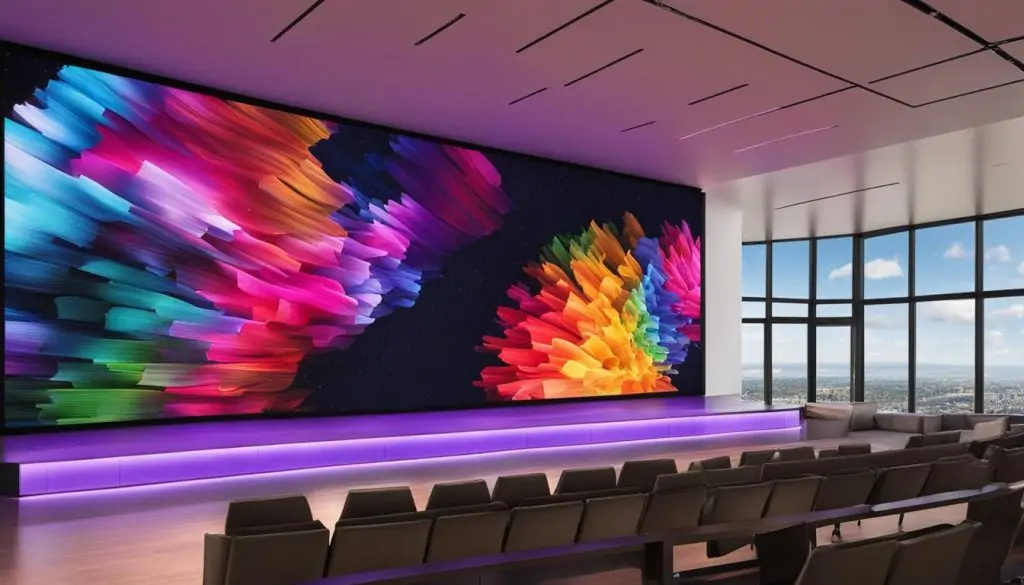
Nebuloid builds the wall on either a large interactive LED surface, a multi-panel touch video wall, or a projection surface with touch or gesture sensing, depending on your venue, budget, and ambient light. Tile size is deliberately generous so that flipping requires an arm movement rather than a fingertip, because the physical gesture is a substantial part of why the installation attracts spectators. Response is tuned so a flip registers instantly with a satisfying animation and sound, since any hesitation in feedback makes a large touch surface feel unresponsive.
Game modes are configured for the audience you expect. A solo timed mode suits individual visitors who want a quick attempt. A cooperative mode lets a family or a group of colleagues work the wall together, which is where the shouting and pointing starts. A head-to-head mode splits the wall into two mirrored grids so two players or two teams race the same layout side by side, and this is consistently the mode that draws the biggest crowd. Difficulty adapts through grid size, exposure time, and whether matched pairs stay visible, so a children gallery and a technical trade fair can run the same installation at very different intensities.
Content management is designed for teams who need to change assets between events. Tile sets are uploaded and arranged through a browser-based console, so replacing a product range or refreshing a campaign is a content task completed in minutes. Multiple tile sets can be loaded simultaneously and rotated by schedule, which is useful when different sponsors or business units share the same installation across a multi-day conference.
The analytics answer a question marketers rarely get to test directly: which of your assets are actually memorable. The platform logs completion times, move counts, and crucially which tiles were matched early and which were repeatedly missed. Assets that players consistently struggle to place are, quite literally, the ones that fail to register. Alongside participation counts, repeat play, and peak demand, that gives your brand team a genuinely unusual piece of evidence about visual distinctiveness across your portfolio.
Key Features
Wall-Scale Interactive Surface — A large LED, touch video wall, or sensed projection surface sized so tile flipping requires full arm movement, which is what makes the game visible and attractive from a distance.
Branded Tile Library — Every tile face carries your product shots, logo variants, leadership portraits, service icons, or campaign illustrations, so gameplay is sustained study of your brand assets.
Multiple Game Modes — Solo timed rounds, cooperative group play, and head-to-head split-wall duels are all available on the same installation and can be switched between sessions.
Adaptive Difficulty — Grid size, exposure duration, timer length, and whether matched pairs remain visible are all tunable, so children and expert audiences can play the same wall appropriately.
Instant Tactile Feedback — Flip animations, match confirmations, and sound design are tuned for immediate response, because perceived lag is what makes large interactive surfaces feel broken.
Live Leaderboard — Fastest completion times and lowest move counts rank across the session, the day, and the whole event, driving repeat attempts and spectator interest.
Scheduled Tile Set Rotation — Multiple tile sets can be loaded and rotated automatically, which lets different sponsors, business units, or campaign themes share one installation across a multi-day event.
Browser-Based Content Console — Your marketing team uploads and arranges tile artwork independently, so refreshing the wall for a new campaign takes minutes rather than a development cycle.
Recall Analytics — The platform records which tiles were matched quickly and which were repeatedly missed, producing a direct read on which brand assets are visually memorable.
Operator and Attract Modes — A host tablet manages registration, mode, and difficulty, while an attract state cycles the leaderboard and a demonstration round to recruit the next player.
How It Works
Step 1 — Tile Set and Mode Design: Nebuloid works with you to select the brand assets that become tile faces and to choose the game modes, grid sizes, and difficulty profiles for your expected audience.
Step 2 — Wall Specification and Build: The interactive surface is specified as LED, touch video wall, or sensed projection based on your venue and ambient light, then installed, aligned, and touch-calibrated.
Step 3 — Experience Development: Tile artwork, flip animations, match effects, timer graphics, leaderboard, and attract sequence are produced in your brand language and loaded to the show computer.
Step 4 — Player Onboarding: A host selects solo, cooperative, or head-to-head mode and captures a name or team tag on the control tablet, which takes only seconds.
Step 5 — The Round: The grid reveals briefly, then hides, and players reach across the wall to flip tiles, holding positions in memory while the clock and move counter run live.
Step 6 — Completion and Ranking: Matching all pairs stops the clock, the result posts to the leaderboard with time and move count, and a short branded message reinforces the assets just studied.
Step 7 — Reset and Reporting: The wall reshuffles instantly for the next player while the platform logs completion data, per-tile recall performance, and demand patterns.
Business Benefits
Sustained voluntary attention on your assets. Players study your product shots and logos intently for a full minute or more because the game requires it, which is attention no passive display can buy on a crowded floor.
Universal accessibility. Memory match needs no language, no instruction, and no physical fitness, so the installation includes children, executives, older visitors, and international guests equally.
Group participation drives noise. Cooperative and head-to-head modes turn a quiet puzzle into a shouting match, and that audible energy is what pulls passing traffic toward your stand.
Genuine recall evidence. Per-tile analytics show which assets players remember and which they repeatedly miss, giving your brand team rare empirical feedback on visual distinctiveness.
Extremely fast re-theming. Because tiles are just artwork in a content console, the same wall serves an entirely different campaign or sponsor within minutes rather than requiring a rebuild.
Efficient use of existing screens. Where a venue or stand already has a large LED wall, the game can often run on that surface, delivering a full interactive activation at marginal additional cost.
High throughput with low staffing. Rounds are short, the wall reshuffles instantly, and one host can manage the queue, so participation numbers stay high through peak hours.
Technical Specifications
Surface Type: Interactive LED wall, multi-panel touch video wall, or sensed projection (configurable) Wall Size: 2.5 metres to 6 metres wide, height set to audience reach profile (configurable) Interaction: Projected capacitive touch, infrared touch frame, or camera-based gesture sensing Grid Sizes: 3x4 up to 6x8 tiles depending on difficulty and audience (configurable) Tile Content: Product images, logo variants, portraits, icons, illustrations, or short loops Game Modes: Solo timed, cooperative group, head-to-head split wall Round Duration: 45 to 120 seconds depending on grid size (configurable) Compute: Industrial show PC with dedicated graphics and solid-state storage Control: Operator tablet for mode selection, difficulty, registration, and reset Audio: Powered speakers with flip, match, countdown, and completion sound design Leaderboard: Fastest time and lowest move count by session, day, and event Content Management: Browser-based console with multiple tile sets and scheduled rotation Analytics: Completion times, move counts, per-tile recall performance, repeat play, hourly demand Connectivity: Ethernet or Wi-Fi with offline-capable local operation Power: Single-phase supply, UPS-ready for continuous operation Mounting: Freestanding truss, wall-mounted, or integrated into stand architecture Accessibility: Reachable tile zones, high-contrast artwork, and seated-player grid option Operating Mode: Continuous event-day operation with attract loop and demo round Support: Remote monitoring, on-site operator options, and preventive maintenance plans
Applications Across Industries
Retail and Consumer Brands — Tiles carry the product range so shoppers memorise the portfolio while playing, which is particularly effective for brands with many similar-looking variants.
Exhibitions and Trade Fairs — Stand teams use the wall as an inclusive crowd-builder that works for the visitors who avoid physically demanding installations.
Pharmaceutical and Healthcare — Medical education teams match molecules to indications or devices to procedures, embedding clinical associations through play at conference booths.
Banking and Financial Services — Tiles pair products with benefits or services with life stages, turning a dense proposition set into a memorable matching exercise.
Education and Science Centres — Learning teams match concepts to examples, species to habitats, or historical figures to events for curriculum-aligned group play.
Corporate Onboarding and Town Halls — Internal teams match leaders to functions or values to behaviours, making induction content genuinely engaging for new joiners.
Automotive Showrooms — Tiles pair models with features or technologies with benefits, keeping customers engaged while sales conversations progress nearby.
Government and Public Awareness — Public bodies match schemes to beneficiaries or safety symbols to meanings for civic education at large public events.
Hospitality and Family Entertainment — Hotels, malls, and family venues run the wall as an inclusive attraction for mixed-age groups during festival periods.
Why Choose This Solution
Nebuloid uses the game format that has the widest possible reach. Memory match requires no language, no fitness, and no explanation, which means the installation engages the substantial share of your audience that skips competitive or physically demanding activations entirely.
We design for the reach, not the tap. Tile size, wall height, and grid layout are set so play is a full-body action visible from across the hall, because a large screen with fingertip interaction attracts nobody standing twenty metres away.
The brand assets do the work. Rather than decorating a generic game, the tiles are your portfolio, so the mechanic and the message are the same thing and every second of play is a second of studied attention.
We deliver recall evidence you cannot get elsewhere. Per-tile match performance is a rare, direct signal about which of your visual assets actually register with real audiences under time pressure.
Re-theming is trivial. Uploading a new tile set through the console converts the installation to a new sponsor, campaign, or business unit in minutes, which matters enormously across multi-day conferences.
It can often use screens you already have. Where a stand or venue already includes a large LED wall, Nebuloid can deploy the game onto that surface, giving you a full interactive activation for a fraction of a dedicated build.
Ready to Deploy
If you want an installation that everyone in your audience can play and that puts your products in front of them for a full concentrated minute, the Giant Memory Match Wall is ready to be built around your brand. Nebuloid will select the tile assets, design the grid and modes for your audience, specify or reuse the right display surface, and deliver a tested installation with operators and reporting.
Send us your venue plan, audience mix, and the assets you want remembered, and we will return a wall specification, tile set design, and commercial proposal. Talk to Nebuloid about deploying a Giant Memory Match Wall at your next exhibition, showroom, or public event.