
Delhi Water Expo and Sport India 2026 runs from 19 to 21 August across Halls 11 and 12A, and the decision to place water technology alongside sports infrastructure and fitness equipment under one roof creates a visitor mix that rewards exhibitors willing to plan beyond a printed backdrop and a table of brochures. Across the three days the aisles carry municipal engineers assessing filtration and wastewater systems, consultants specifying pumps and pipework for township developments, procurement officers from state utilities and civic bodies, academy owners pricing synthetic turf and modular sports flooring, gym operators comparing strength and cardio equipment, and a steady flow of students and enthusiasts who arrive simply because sport attracts crowds in a way that industrial plant does not. Nebuloid Tech Studio treats that asymmetry as the central design problem of the show rather than as an inconvenience to be absorbed. A water treatment brand holding a modest plot in Hall 11 rarely needs the loudest activation on the floor; it needs an experience that filters passing traffic, holds the right thirty or forty visitors for five or six minutes each, and frees the technical team to hold real conversations instead of repeating the same introduction two hundred times a day. A sports flooring or fitness equipment brand in Hall 12A faces the opposite challenge, because the product is genuinely enjoyable to demonstrate and the real risk is generating large volumes of participation that never convert into a qualified conversation with a decision maker. Hall geography matters more than most exhibitors expect. Halls 11 and 12A sit adjacent, so visitors tend to move between them in loops rather than walking a single planned route, which means corner plots and aisle-facing edges carry disproportionate value, and any screen mounted flat against a back wall will be seen by a fraction of the people who pass the stand. August in Delhi adds its own rhythm. Monsoon humidity pushes visitors indoors and keeps them inside longer once they arrive, so dwell time within the halls is usually healthier than at winter shows, while the first hour after opening stays quiet and genuine density builds from late morning through mid afternoon. Day one carries the technical and specifying audience, day two produces the highest footfall and the noisiest floor, and day three thins out but often delivers the most decisive conversations because visitors return with a shortlist and a colleague. Activation content should be planned against that curve rather than against a daily average. Short interaction loops of sixty to ninety seconds keep queues moving through the day two peak, while the same installation can switch into a longer and more consultative mode on the first morning and the final afternoon, when the people standing in front of you are worth ten unhurried minutes each. Planning at this level of specificity is what separates a stand that produces a reportable pipeline from one that produces footfall photographs, and the work begins weeks before the hall doors open, at the point where the activation concept, the staffing plan, and the lead capture flow are designed as a single connected system rather than bought as three unrelated line items from three unrelated vendors.
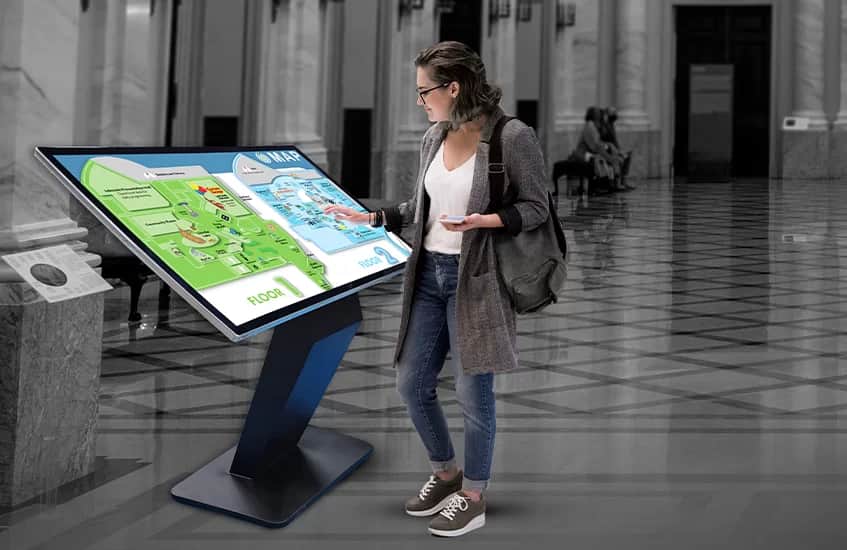
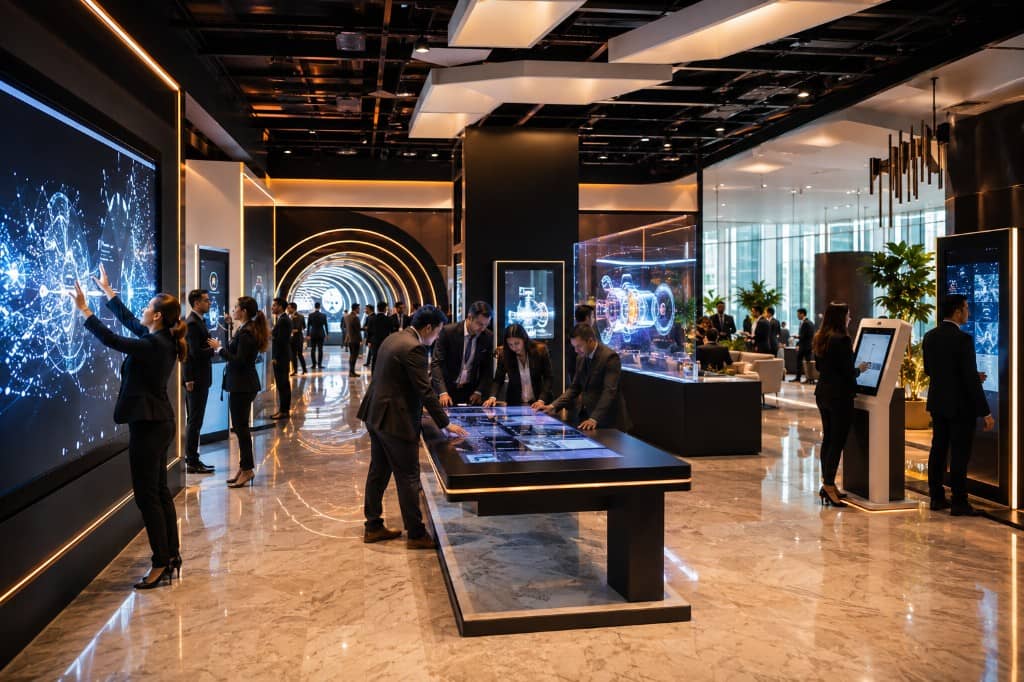
The activations that perform at Delhi Water Expo and Sport India are the ones that make an invisible process visible or a physical claim testable, and Nebuloid Tech Studio builds them around that single test. For water technology exhibitors in Hall 11, the most dependable format is an interactive process table: a large horizontal touch surface carrying a schematic of a treatment plant, a desalination line, an effluent recovery loop, or a municipal distribution network, where a visitor taps any stage and immediately sees the chemistry, the energy load, the maintenance interval, and the common failure mode of that stage explained in under thirty seconds. Because the table is horizontal, three or four people gather around it as a group, which is exactly how utility teams and consulting engineers actually visit a show, and the salesperson stands with them rather than across a counter from them. A second reliable format is an augmented reality cutaway delivered on a tablet or a large vertical screen, where pointing a camera at the physical pump, valve, membrane housing, or dosing skid on the stand reveals the internal flow path, wear points, and serviceable components without cutting an expensive unit in half for display. For brands whose value sits in monitoring rather than hardware, a live sensor demonstration works better than any animation: run real water through a compact rig, show turbidity, pressure, flow, and chlorine residual moving on a dashboard in real time, and let a visitor introduce a fault by closing a valve so the alarm logic proves itself in front of them. A leak-detection challenge built as a short game, where two visitors race to locate non-revenue water losses across a city map before a timer expires, converts a dry commercial argument about network efficiency into something a procurement officer will remember on the drive home. On the sport side in Hall 12A the design principle inverts: the game must be the product demonstration, never a distraction from it. A reaction light wall belongs to a brand selling agility and training systems, a tracked penalty shootout or bowling speed lane belongs to a brand selling turf and netting, a sprint or agility lane laid on the actual flooring product lets a visitor feel grip and shock absorption through the legs instead of reading a specification sheet, and a jump-height or vertical-leap station with an automatic leaderboard belongs to a brand selling performance equipment. Instrumented cycling and rowing rigs suit fitness equipment exhibitors because they combine visible effort, spectator noise, and a defensible metric. Add an artificial intelligence photo station that places participants in a stadium environment or club kit, deliver the image by QR code within seconds, and the activation continues working through social feeds after the visitor leaves the hall. Two cautions apply to both halls. Avoid headset-based virtual reality as a primary crowd mechanic in humid August conditions and high throughput, because hygiene, sanitisation time, and one-visitor-at-a-time bottlenecks quietly destroy the numbers you were promised. And control audio deliberately, because Halls 11 and 12A are shared acoustic environments where an uncalibrated sound system earns complaints from neighbouring exhibitors and organisers long before it earns you a lead.
Delivery discipline is what converts a good activation concept into a working stand on 19 August, and the operational realities of a Pragati Maidan build are unforgiving of assumptions. Confirm the hall allocation, stand number, and build window for Halls 11 and 12A directly with the organiser in writing, because sanctioned build hours, vehicle access slots, and material movement routes are controlled tightly and a single missed gate pass can cost a full day of installation time. Declare electrical load honestly and early. Interactive installations draw more than exhibitors estimate once large displays, projectors, show computers, sensors, lighting, and charging stations are counted, and Nebuloid Tech Studio always specifies a load schedule with headroom, requests the correct single-phase or three-phase supply, and brings uninterruptible power supply units for every show computer so a momentary hall dip does not force a two-minute reboot in front of a waiting queue. Assume the venue wireless network will be congested and unreliable across all three days, then build every experience to run fully offline with local data buffering and a scheduled sync, so leaderboards, media delivery, and lead capture keep working when four thousand phones are competing for the same spectrum. Check rigging permissions before designing anything overhead, keep structures floor-standing on ballasted truss where ceiling rigging is restricted, keep cable runs inside covered channels along the stand edge, and route foot traffic so the queue forms inside your plot rather than spilling into a shared aisle where safety marshals will disperse it. Staffing decides throughput more than technology does. Nebuloid Tech Studio plans one trained host per interactive station for pacing, resets, and name capture, plus your own technical or sales specialist positioned immediately beyond the activation to receive warm visitors, and rehearses a fifteen-second invitation script and a thirty-second qualifying question set with the full team before the show opens. Lead capture must be a single deliberate step inside the experience rather than a clipboard afterthought. Capture name, organisation, role, project stage, and consent through a short digital form or a badge scan tied to the participation record, tag the specific interest area the visitor explored on the process table or the challenge lane, and push everything into the customer relationship system the same evening so follow-up leaves within forty-eight hours while recall is still intact. Measurement should be agreed before the build, not invented afterwards. Track participations per hour, average dwell, unique qualified conversations, cost per qualified conversation, hall-wise and day-wise performance, and the volume of media shared by visitors, then compare day one, day two, and day three against the traffic curve you predicted so the next show is planned on evidence rather than sentiment. Finally, treat the installation as an asset with a life beyond these three days. The process table, augmented reality cutaway, leaderboard platform, and photo station built for 19 to 21 August can be re-skinned for the packaging, healthcare, and imaging shows that follow in the same Delhi calendar month, which is how exhibitors amortise a serious experiential investment across a season instead of writing it off against a single event.