
The India International Footwear Fair 2026 runs from 5 to 7 August and spreads across Halls 4FF, 5GF and Hall 6, and that layout is the first strategic fact any exhibitor should absorb, because it shapes visitor behaviour more than any stand design decision you will make afterwards. A show split between a first-floor hall and two ground-floor halls does not deliver a single evenly distributed crowd. It delivers a ground-floor stream that flows naturally from the entrance and a first-floor population that has to be earned, because every additional staircase or escalator between a visitor and your stand removes a proportion of casual traffic. If you are in Hall 4FF, you should assume that people who reach you have made a deliberate decision to come upstairs, which means your visitors are fewer but better qualified and your wayfinding, pre-show communication and appointment discipline matter enormously. If you are in Hall 5GF or Hall 6, you will see more volume and more passing traffic, which means your challenge is the opposite one, namely filtering a broad crowd quickly so your team spends its time on genuine buyers rather than on everyone with a bag and a badge. The audience itself is layered in a way that few other categories are. Footwear brings together retail buyers and distributors looking for ranges and margins, sourcing agents comparing units and lead times, component and material suppliers selling soles, uppers, adhesives, insoles and hardware, machinery manufacturers selling equipment for cutting, lasting, stitching and finishing, and a design community interested in materials, comfort technology and sustainability claims. Each of these groups walks the floor with a different question, and a stand that answers only one of them wastes a substantial share of the traffic that passes it. What all of them share is the tactile nature of the category. Footwear is a product people pick up, flex, press, smell and turn over in their hands, and no screen will ever replace that. This is precisely why purely digital activations underperform at footwear shows when they are designed as a substitute for the product rather than as a companion to it. The winning approach at IIFF is a paired one, where the physical product stays entirely accessible and the digital layer answers what the sample alone cannot show, namely the full range that could not be shipped to the hall, the colourways that exist but were not sampled, the manufacturing process behind the construction, the material sourcing story a buyer will need in order to sell it onward, the customisation options available at order stage, and the commercial terms across volume bands. Understood that way, an activation stops being an add-on and becomes a merchandising tool, and it starts contributing to the only outcome that matters at a three-day trade fair, which is the number of serious buyers who leave your stand with a clear picture of what you make and a genuine reason to place an order or schedule a factory visit. Everything that follows assumes that single goal, because at a three-day fair spread across a first-floor hall and two ground-floor halls, attention is the scarce resource, and every square metre of your stand should be earning some part of it rather than simply occupying space.
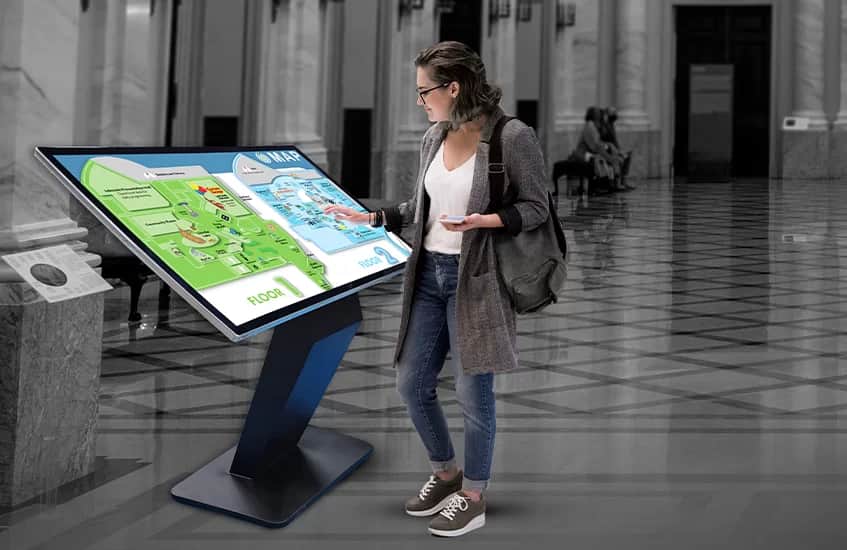
Once the audience is understood, the format choices become far more obvious, and a handful of them consistently work well on a footwear and leather floor. A digital range browser on a large touchscreen is the highest-value and lowest-risk investment for most exhibitors, because almost every brand at IIFF is showing a fraction of what it actually produces. Instead of apologising for the gaps in a sample wall, your team can pull up the complete catalogue on screen, filter by category, price band, construction, sole type or material, and build a shortlist with the buyer standing beside them, which turns a browsing conversation into a structured buying conversation. A virtual try-on or scaled visualisation station works well for consumer-facing brands and for retail buyers who need to imagine a range in their own store, letting a visitor see styles rendered on a foot or on a shelf layout rather than as loose samples on a table. Foot measurement and comfort demonstrations are particularly effective for orthopaedic, safety, sports and comfort-led ranges, because a short scan or pressure demonstration turns an abstract technical claim into something a visitor experiences on their own body, and that is an extremely durable memory. A material and craft story wall, built as a touch surface or a projection panel with real material swatches mounted alongside it, gives sourcing agents and designers the provenance and process detail they increasingly need, and it works well for tanneries, component suppliers and sustainability-led brands whose story is genuinely their differentiator. For machinery and component exhibitors in the halls, a process visualisation that shows where a specific component or machine sits within a complete shoemaking sequence is far more useful than a specification sheet, because it lets a factory owner see the change in their own line rather than the part in isolation. A customisation configurator, where a visitor assembles a shoe by choosing upper material, colour, sole and hardware and sees the result rendered instantly, is a reliable crowd generator and doubles as a genuine sales instrument for brands that offer private-label or made-to-order production. Around these, a single light-hearted element such as a branded photo moment with an instant digital send, or a short game with a small daily prize, keeps energy on the stand during slow periods and gives your team an easy way to open with a hesitant visitor. Nebuloid tends to advise against building more than two or three interactive elements on a typical IIFF stand, because a crowded stand splits both visitor attention and staff attention, and two well-run stations always outperform five neglected ones. The test for every element should be a simple one. Does this help a buyer decide, or does it merely help us look modern? If the answer is the second, remove it and put the money into better lighting, better sample presentation and a better trained team, all of which will earn more orders across the three days. That discipline of subtraction is what separates a stand that feels considered from one that feels assembled, and experienced footwear buyers register the difference within seconds of stepping in.
The operational side of an IIFF activation deserves the same seriousness as the creative side, and a few specifics recur every year in Delhi NCR halls. Because the show is spread across Halls 4FF, 5GF and Hall 6, wayfinding is a genuine commercial variable rather than a housekeeping detail. Exhibitors on the first floor should invest properly in pre-show outreach, telling existing buyers exactly where to find them, confirming appointment slots in advance, and using every listing, mailer and social post to repeat the hall number, because a buyer who cannot find you will simply meet somebody else. Ground-floor exhibitors should think about sightlines instead, ensuring that the stand reads clearly from the aisle at a distance and from both directions of travel, since footwear halls generate heavy two-way traffic and a stand designed to be seen from only one approach loses half its potential stops. Build days for an early August show are hot and compressed, so any custom fabrication, screen mounting or interactive rig should be assembled and content-tested off site, then transported flight-cased and ready, with spare media players, cables and a spare display panel on site rather than in a warehouse. Assume the hall network will fail at the worst moment and build every interactive element to run offline with local data storage and later synchronisation. Lighting deserves specific attention at a footwear show because colour accuracy affects buying decisions directly, so plan your stand lighting and your screen brightness together, and check that screens are not washed out under hall lighting or reflecting the aisle behind them. Staffing should be structured around the split between browsing and buying. Assign one person to work the interactive station and keep it busy, and keep your senior commercial people free for serious buyers rather than letting them get absorbed in demonstrations, which is a common and costly pattern on busy stands. Data capture should be lean and connected to intent, capturing name, company, city, buying role and the specific styles or components the visitor engaged with, so that follow-up can reference exactly what they looked at rather than a generic list. That connection between behaviour and follow-up is where most of the commercial value of an interactive stand actually sits, and it is the part most often neglected once the show ends. Run a short debrief at the close of each of the three days, look at which styles were opened most often in the digital browser and which stations were busiest, and adjust your sample table, your screen content and your opening line the next morning. After the fair, contact every serious lead within the first week, lead with the specific range or component they engaged with, and include a link to the same digital catalogue they used on the stand so the experience continues in their office. Finally, build the platform once and reuse it. The same range browser, configurator and content framework should serve your next edition of IIFF, your regional trade shows and your distributor meetings, which is what turns a three-day activation into a permanent sales asset.