
The 12th India International MSME Expo and Summit takes place from 10 to 12 August 2026 in Hall 4FF, and the single-hall format changes the strategic picture completely compared with the sprawling multi-hall shows that dominate the Delhi NCR calendar. When an entire event sits inside one hall, almost every visitor will physically pass almost every stand at some point across the three days. That is a considerable gift, because it removes the wayfinding problem that costs exhibitors so much at larger fairs, and it also removes an easy excuse. If your stand is quiet at this show, it is not because people could not find you. It is because they walked past and saw no reason to stop. The audience mixture is what makes this event distinctive. In one hall you will find small and mid-sized manufacturers exhibiting their capability, larger buyers and procurement teams scouting suppliers, financial institutions and lending partners, technology and services vendors selling into the MSME sector, industry association representatives, policy and government officials connected to the summit programme, consultants, students and a steady flow of entrepreneurs who are simply looking for their next idea, partner or vendor. That mixture means the person standing in front of your stand might be a buyer, a supplier, a competitor, a potential distributor, an investor, or somebody who wants to sell you something, and the practical consequence is that qualification speed becomes your most valuable operational skill across the three days. The second defining reality is budget. Most exhibitors at an MSME expo are working with a fraction of the spend available to a multinational at a flagship trade fair, and advice built for large budgets is not merely unhelpful here, it is actively misleading. The good news, and it is genuinely good news, is that engagement at this show is not decided by spend. It is decided by clarity. The most common failure on an MSME stand is not a lack of technology or fabrication budget. It is that a visitor walking past cannot tell within a few seconds what the company makes, who it makes it for, and why it is worth a conversation. Stands are routinely filled with company names, certificates, awards, group photographs and dense text panels, and almost none of that answers the question in the visitor mind. A stand that states plainly what it manufactures, for which industries, at what scale, and what it is looking for at this expo, will out-engage a far more expensive stand that says nothing specific at all. Everything else described here, including every piece of interactive technology, works only after that fundamental clarity exists. Technology on an MSME stand should be understood as an amplifier of a clear proposition, never as a substitute for one, and any vendor who suggests otherwise is selling hardware rather than results. Get the message right first, and then decide what deserves a screen. A single sentence set large across the fascia, saying precisely what you manufacture and for whom, remains the cheapest and most effective engagement tool available to any exhibitor in Hall 4FF, and it costs nothing beyond the discipline required to write it honestly.
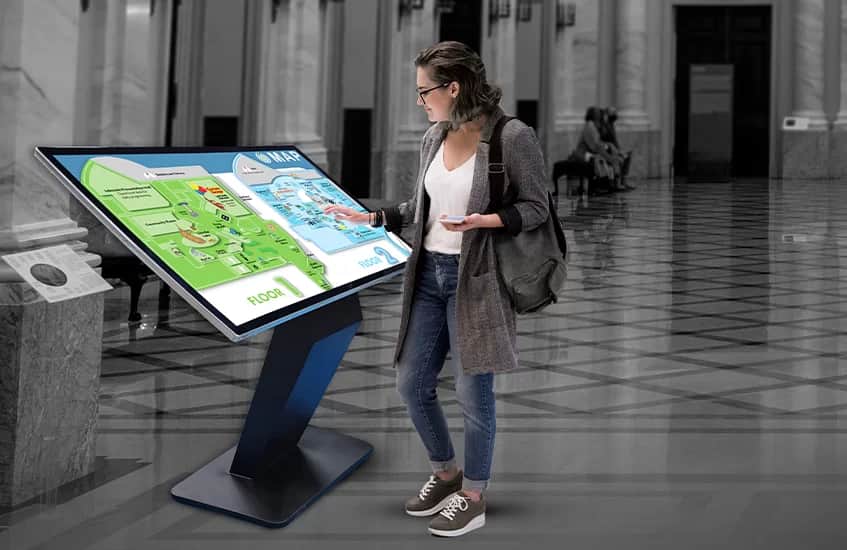
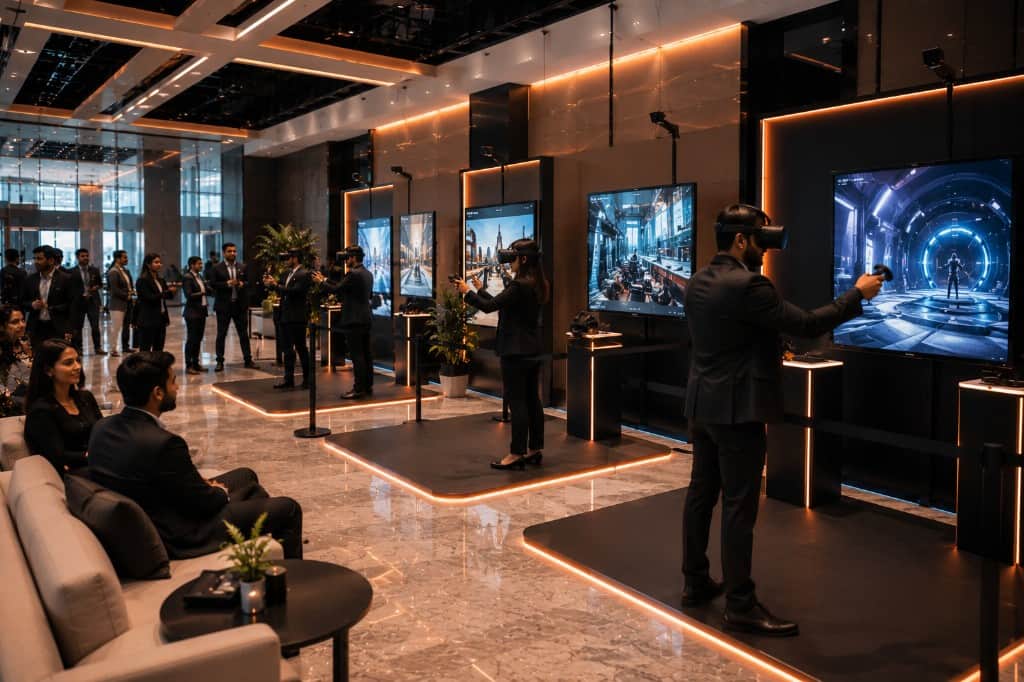
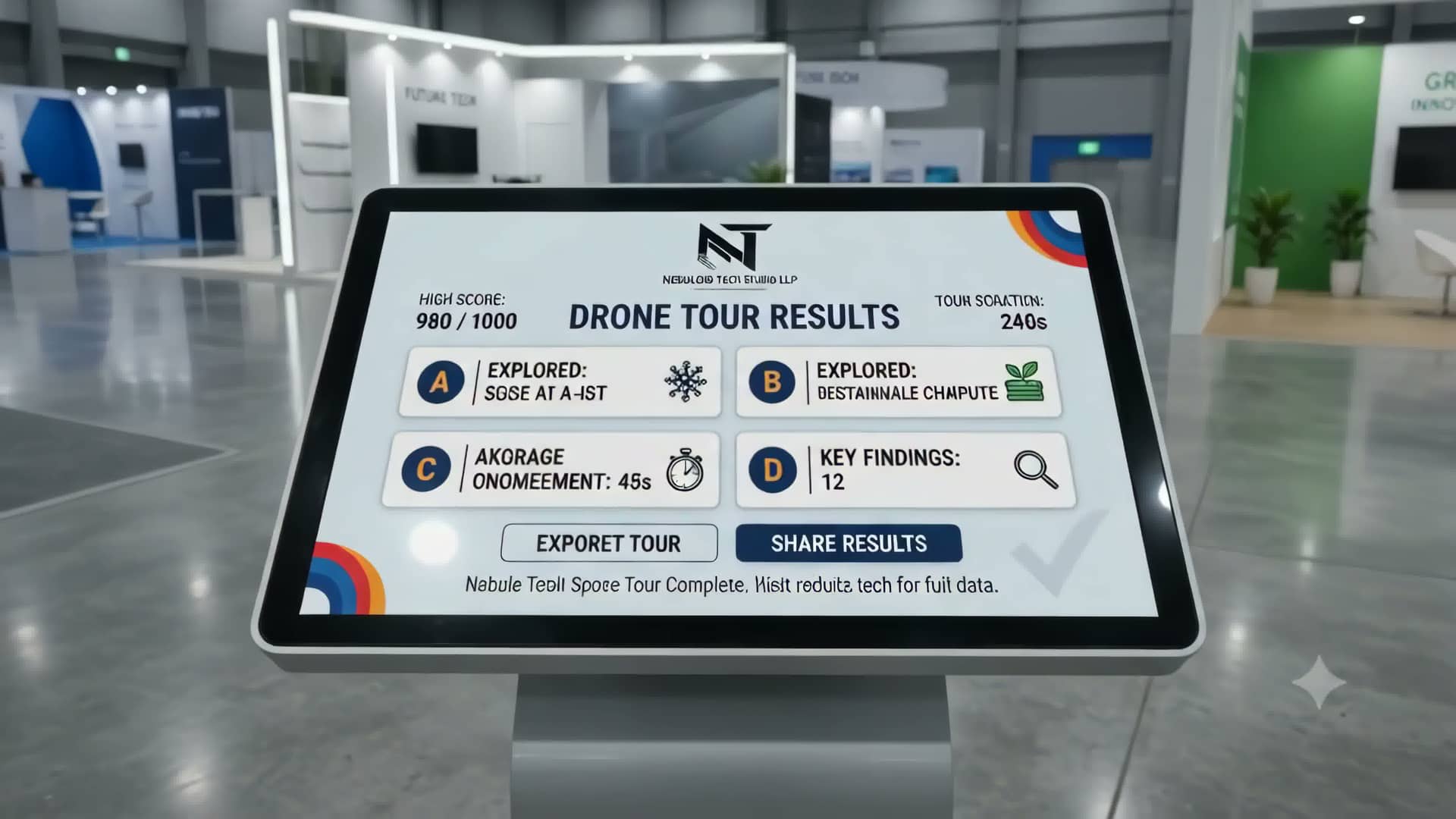
With that foundation in place, there are several genuinely affordable engagement formats that suit a single hall and an MSME budget, and each of them earns its cost by doing work that a printed brochure cannot. The most useful starting point for almost any manufacturer is a touchscreen capability presentation, which is simply a well-designed digital version of everything a visitor might want to see about your factory. Instead of a folder, a visitor can tap through your product range, your machine list, your certifications, your capacity by month, your export markets, and a short video walkthrough of your plant. The reason this matters more for a small manufacturer than for a large one is that credibility is your hardest problem at this show. A buyer who has never heard of your company needs evidence that you can deliver, and a two-minute factory walkthrough on a screen provides that far more convincingly than a claim on a banner. A second highly effective format is a simple quiz or diagnostic tool relevant to your category, where a visitor answers four or five short questions and receives a tailored output such as a recommended product configuration, a suitable service tier, or a checklist of what they should consider before buying. This works because it flips the interaction, making the visitor the subject of the conversation rather than your company, and it produces a natural, non-pushy reason to exchange contact details. Third, a digital lead capture system built around a QR code and a short tablet form removes the visiting-card pile that most MSME exhibitors lose track of within a fortnight of the show. When contact details, interest area and a simple priority tag are captured digitally on the spot, follow-up becomes an organised process rather than a memory exercise. Fourth, for exhibitors whose offering is tied to government schemes, credit programmes or certification support, an interactive explainer that lets a visitor identify their enterprise category and see which programmes and processes apply to them is one of the most appreciated tools you can put on a stand, provided the content is kept factual, current and free of exaggerated claims. Fifth, a compact photo or video moment, ideally with instant delivery to the visitor phone, gives your stand visible activity, and visible activity attracts more visitors in a single hall where people can see across the aisles. Finally, if you sell a physical product that is hard to transport, a three-dimensional viewer or a short immersive walkthrough lets you show a large machine, an installation or a facility that could never have been brought into Hall 4FF. Across all of these, Nebuloid consistently advises MSME exhibitors to pick exactly one interactive element and execute it properly rather than attempting three on a small stand with a small team, because a single station that is always staffed, always working and always busy will generate more qualified conversations than a cluttered stand where nothing is quite finished. Choose the element that removes your single biggest sales obstacle, whether that obstacle is credibility, complexity, or the difficulty of explaining what you actually do, and build that one thing to a standard you are proud of. Everything else can wait for the next edition.
Running the stand well across 10, 11 and 12 August is where the plan turns into results, and the operational discipline required is not expensive, only deliberate. Start with staffing, because on an MSME stand the team is usually two or three people, often including the owner, and their time is the scarcest resource in the building. Agree in advance who greets, who demonstrates and who handles serious commercial discussions, and agree a simple rule for handing a promising visitor from one to the other. Write a fifteen-second opening that states what you make and asks one qualifying question, and have everybody use it, because an inconsistent opening is the reason most stands feel unfocused by the middle of day two. Build a three-tier qualification habit and use it out loud, separating visitors who are ready to buy, visitors worth nurturing, and visitors who are pleasant but commercially irrelevant, so that nobody spends twenty minutes explaining the business to somebody who will never place an order. The summit programme that runs alongside the exhibition deserves specific planning rather than casual attendance. Sessions pull people away from the floor in waves, which means the hall empties and fills in a rhythm you can anticipate, and a small team should decide in advance who attends which session, what they are trying to learn or whom they are trying to meet, and who stays behind to hold the stand. If anyone from your company is speaking, treat that as a lead-generation opportunity and make sure your stand number is visible in the deck and mentioned clearly at the end. Plan for the practical constraints of the hall as well. Power should be checked on build day and every device given surge protection, hall connectivity should be assumed unreliable so any interactive element must work offline and store data locally, and screen positions should be checked for glare from hall lighting before the show opens rather than during it. Keep a small supply kit on the stand containing spare cables, a power strip, adhesive, cleaning cloth, a spare tablet charger and a printed backup of your key content, because the difference between a minor fault and a lost day is often a two-hundred-rupee item. Review performance at the end of each day, counting conversations rather than footfall, noting which questions came up repeatedly, and adjusting your opening line and your screen content overnight. Three days is enough time to improve twice if you are paying attention. After the expo, follow up within the first working week while your company name still means something, referencing the specific thing each person engaged with, and separate your list into buyers, partners and long-term contacts so the messages are appropriate to each. The final point is the one that transforms this from an expense into an investment. Everything you build for Hall 4FF, from the digital capability presentation to the diagnostic tool to the lead capture flow, should be reusable at your next exhibition, on your website, in your sales meetings and in your distributor conversations, which is how a modest MSME budget compounds into a sales system rather than evaporating after three days.